Low MOQ Custom Packaging: How Small and Medium Food Brands Can Get Started
Introduction
For a small food brand, custom packaging can help a product look established without requiring a large inventory commitment. The challenge is finding a supplier whose minimum order quantity (MOQ), packaging format, and production process fit the size of the launch. Low MOQ custom packaging gives businesses a way to test a design or product run before committing to larger volumes. This guide explains how to compare formats, estimate the real cost, check food-contact requirements, and evaluate suppliers.
What Is Low MOQ Custom Packaging?
Low MOQ custom packaging is packaging produced with a relatively small minimum order, allowing a business to order closer to its near-term needs instead of buying large quantities upfront. There is no universal unit threshold: the minimum depends on the format, material, printing method, finishing, and supplier. For some projects, custom labels on stock containers may be the most accessible starting point; fully printed pouches, cartons, and rollstock can have different minimums.
Why Printing Method Affects Minimum Order Quantity
Printing method is one of the main factors that determines whether a packaging order can be produced economically at low volume. Digital printing transfers artwork without the conventional printing plates or engraved cylinders used by many flexographic and gravure workflows. That can make short runs and design changes more practical, although digital printing is not automatically the cheapest option for every material or quantity. Traditional processes may offer a lower unit price at higher volumes, while tooling, setup, and minimum charges can make a small run less economical. Ask suppliers to quote the same specification and quantity so the comparison reflects total cost rather than unit price alone.
Packaging Formats to Consider for Small-Quantity Orders
Custom packaging for small business projects can use fully printed packaging or standard packaging finished with custom labels. The best choice depends on the product’s protection needs, filling process, shelf presentation, and budget.
| Format | Potential fit | What to confirm |
| Stand-up or lay-flat pouches | Snacks, granola, coffee, tea, dried fruit, and similar products | Barrier structure, closure, filling method, seal performance, and food-contact suitability |
| Rollstock film | Brands or co-packers using compatible form-fill-seal equipment | Equipment compatibility, roll dimensions, registration, and minimum run |
| Stock jars, bottles, or boxes with custom labels | Early-stage products that can use standard containers | Label adhesion, available container sizes, label material, and required product information |
| Folding cartons | Dry goods, baked products, gift sets, and secondary packaging | Paperboard material options, dimensions, finishing, cutting-die or setup charges, and product protection |
Early-stage brands frequently combine stock containers with custom labels, or use ready structures such as paper boxes and containers.
How to Estimate the True Cost
True cost in custom packaging small quantity orders is the total amount a brand actually spends, including setup, samples, freight, and the risk of unused inventory—not the unit price alone. The price per unit is only one part of the cost of custom packaging small quantity orders. Compare the full quote, including any artwork or prepress charge, plates or tooling, samples, finishing, freight, taxes or duties, and any minimum order or setup fee. Also consider the cost of unused stock if a recipe, label, product size, or market requirement changes.
A smaller run may have a higher unit price but require less cash upfront. A larger run may reduce the unit price while increasing storage needs and the risk of obsolete inventory. Request itemized quotes for at least two quantities and compare the total landed cost for each option.
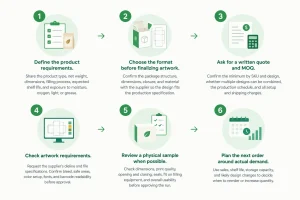
A Practical Process for Ordering Low MOQ Custom Packaging
Food-Contact Compliance: What Buyers Should Ask
Food-contact compliance means that the packaging materials and their intended use meet the legal requirements that apply to contact with food in the destination market. Requirements vary by market, material, food type, and conditions of use, so do not assume that a generic statement such as “food grade” is sufficient.
For the United States, FDA food-contact requirements can apply to substances used in adhesives, paper and paperboard components, polymers, and other materials; the relevant provisions depend on the specific substance and intended use. [1] For the European Union, food-contact packaging must be assessed against the applicable framework and material-specific rules. In addition, the EU Packaging and Packaging Waste Regulation (PPWR) has applied since 12 August 2026, including PFAS limits for food-contact packaging. [2] Certain PFHxA-related restrictions for paper and cardboard food-contact materials under REACH also take effect on 10 October 2026. [3]
Before ordering, tell the supplier where the product will be sold and how the package will be used. Ask for relevant declarations, test reports, or supporting documentation for the actual material and intended conditions of use. Do not treat this article as legal advice; confirm requirements for your product and destination market.
How to Choose a Supplier
| Check | Questions to ask |
| MOQ and SKU rules | What is the minimum per size, flavor, or artwork? Can multiple designs be included in one order? |
| Specification and quality | Can you provide a sample, material specification, and clear approval process? |
| Compliance documents | Can you provide documents relevant to the target market and intended food contact? |
| Lead time and delivery | When does the schedule start, what can delay it, and how is shipping calculated? |
| Scaling options | Can the same specification be reordered at a higher quantity, and what changes in price or lead time? |
For brands comparing custom packaging small quantity suppliers, prioritize clear specifications, documented requirements, sample access, and transparent landed pricing—not just the lowest advertised MOQ.
FAQ
Q1: What counts as low MOQ custom packaging?
There is no single industry-wide definition. A low MOQ is a supplier-specific minimum that suits a smaller launch or replenishment order. It varies by packaging format, printing process, material, and design.
Q2: Can I order custom packaging in small quantities?
Often, yes. Stock containers with custom labels may be suitable for very small runs, while printed pouches, rollstock, or cartons may have different minimums. Ask suppliers for the minimum per design and SKU.
Q3: Is low MOQ custom packaging more expensive per unit?
It can be. Setup costs are spread across fewer units, and short-run production may have a higher unit price. Compare the total landed cost and the risk of unused inventory, not just the unit price.
Q4: Should a small food business choose digital printing or flexographic printing?
Digital printing is worth comparing for short runs or frequent artwork changes. Flexographic printing may be more cost-effective at larger volumes. The better option depends on quantity, material, print requirements, and the supplier’s quote.
Q5: What should I provide to get an accurate packaging quote?
Provide product type, package dimensions, target quantity, material or barrier needs, print coverage, finishing, destination, and any required delivery date. If you are unsure about the structure, ask the supplier to recommend options. If you are unsure about the structure, ask the supplier to recommend options, or refer to our packaging design and artwork support page for dieline and file requirements.
Q6: What documents should I request for food packaging?
Ask for documentation relevant to the packaging material, intended food contact, conditions of use, and destination market. The exact documents depend on the material and applicable regulations; a generic “food grade” claim may not be enough.
Q7: Can I change my design on the next order?
Usually, but the cost and process depend on the printing method and supplier. Confirm whether artwork changes trigger new setup, tooling, sampling, or approval charges before placing the first order.
Q8: How can I avoid ordering too much packaging?
Estimate demand conservatively, account for shelf life and storage, and consider whether labels or product information may change. Compare quotes at multiple quantities and choose a run size that balances unit cost with inventory risk.
Conclusion
Low MOQ custom packaging helps small food brands test a product presentation without committing to more stock than they can use. The right decision depends on the packaging format, printing method, complete delivered cost, supplier documentation, and likely demand. Define the product requirements first, compare itemized quotes, and approve the specification and sample before production.
When you are ready to move from research to quoting, you can review current paper packaging products and contact Singreen to discuss formats, specifications, and project requirements.
References
[1] U.S. Food and Drug Administration, “Packaging & Food Contact Substances (FCS).”
[2] European Commission, “New EU rules on packaging enter into application,” 11 August 2026.
[3] European Chemicals Agency / REACH Annex XVII, Entry 79 (PFHxA, its salts and PFHxA-related substances); see also the applicable REACH restriction text.