Wholesale Food Packaging for Distributors: How to Plan Product Range and Inventory
Introduction
Product range and inventory planning is the process of deciding which food packaging SKUs to stock, how much inventory to hold, and when to replenish each SKU based on demand, specifications, compliance requirements, and supplier lead times.
For food packaging distributors, this planning directly affects inventory investment, warehouse efficiency, service levels, and customer retention. B2B buyers prioritize specification fit, food-contact documentation, availability, lead-time reliability, and total cost—not simply the lowest unit price.
The global food packaging market was valued at approximately USD 421.60 billion in 2025 and is projected to reach USD 446.50 billion in 2026. Growth of this scale rewards disciplined range expansion rather than reactive catalogue growth. Distributors that answer five practical questions—core stock selection, special-order vs custom decisions, inventory depth, replenishment frequency, and supplier risk-sharing—can expand without letting SKU proliferation consume working capital.
What Food Packaging Distributors Must Plan Differently
Food packaging distribution planning is a demand-and-supply management process in which SKU availability must be balanced with specification, compliance, lead-time, and replenishment requirements.
Three characteristics make the category different from ordinary wholesale products:
- Many packaging items are recurring purchases. Once a buyer qualifies a format, switching often requires samples, operational checks, or customer approval.
- SKUs multiply quickly through variations in size, material, capacity, printing, case pack, and barrier properties. Carrying every variation raises warehouse complexity and working capital.
- Food-contact packaging requires appropriate regulatory support for its intended use. In the United States, the regulatory status of a food-contact material depends on the substances used and their intended conditions of use, with pathways including applicable 21 CFR provisions, GRAS status, prior sanctions, Threshold of Regulation exemptions, and effective Food Contact Substance Notifications. [1][2]
Range planning should therefore start from demand and qualification requirements rather than simply adding every item from a supplier catalogue.
How to Build a Food Packaging Product Portfolio
Product portfolio planning determines which packaging categories, formats, sizes, materials, and specification tiers a distributor should carry based on customer demand, commercial value, compliance requirements, and supply conditions.
A practical portfolio can be divided into five groups:
| Portfolio Type | Typical B2B Demand | Recommended Inventory Strategy |
| Core replenishment SKUs | High-volume, repeat orders | Maintain reliable stock and frequent review |
| Specification-driven SKUs | Lower volume but important to specific buyers | Keep a focused range with controlled specifications |
| Compliance-gated SKUs | Demand depends on documented eligibility | Stock only after required documentation is verified |
| Custom and private-label SKUs | Customer-specific dimensions, materials, or printing | Plan against confirmed demand or established programs |
| Seasonal and promotional SKUs | Predictable but time-limited demand | Use separate forecasts and control obsolete inventory |
Review the portfolio by customer segment as well as by SKU. A foodservice redistributor may need breadth and depth; a food processor may buy fewer SKUs but require tighter specification control and traceability. High-velocity items such as paper cups often form the backbone of core replenishment ranges. Seasonal or specialized formats like paper ice cream cups can be managed under separate forecast and inventory rules. Related ice cream packaging solutions can help align product selection with specific channel requirements.
Before adding any SKU, check six filters: repeatable demand, clear application fit, available compliance documentation, sufficient margin, consistent supply quality and lead times, and acceptable inventory risk if demand falls or the specification changes. Products that fail these checks rarely justify warehouse depth.
Standard Specification SKUs vs Custom SKUs
A standard specification SKU is a repeatable catalog product with defined specifications. A custom SKU is produced or configured according to customer-specific requirements.
The two categories require different inventory policies:
| Planning Factor | Standard Specification SKU | Custom SKU |
| Demand visibility | Often aggregated across customers | Usually customer- or program-specific |
| Forecasting | Historical demand and statistical models | Confirmed orders or program forecasts |
| Inventory approach | Stock to service-level targets | Prefer order-based or program-based planning |
| Lead time | Usually more repeatable | May involve printing, tooling, or material approval |
| MOQ | Often case-pack driven | Often tied to production runs |
| Obsolescence risk | Manageable | Higher when specifications or artwork change |
| Supplier collaboration | Reorder discipline and lead-time consistency | Sample approval, production planning, documentation control |
Standard SKUs can usually carry more inventory because demand aggregates across multiple buyers. Custom SKUs should avoid speculative stock. When a custom program becomes stable and repeatable, negotiate scheduled production or supplier-held inventory to reduce the safety stock held in the distributor’s warehouse. Distributors can also partner with manufacturers that offer flexible custom food packaging programs to better manage these requirements.
How to Set Inventory Quantities by Demand Pattern
Inventory quantity planning is the process of determining reorder points, cycle stock, and safety stock according to demand variability, lead-time variability, and the required service level.
ABC/XYZ segmentation provides a practical framework:
| Segment | Demand Pattern | Suggested Inventory Policy |
| AX | High volume, stable | Reliable stock, frequent review, disciplined replenishment |
| AY/AZ | High volume, variable | More frequent forecasting and closer safety-stock control |
| BX/BY | Medium volume, moderate variability | Standard reorder-point management |
| CX | Low volume, relatively stable | Controlled min-max or periodic replenishment |
| CZ | Low volume, highly variable | Consider special-order or supplier-supported supply |
Safety stock should reflect actual variability rather than an arbitrary number of weeks of supply. A commonly used statistical model is:
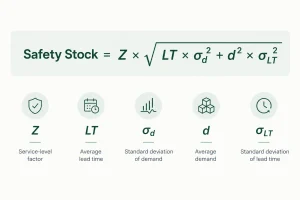
The exact formula depends on available data and company policy; the key principle is to account for the variability that actually drives stockout risk. [3]
For imported packaging, supplier lead-time variability is often the dominant factor.
How to Define Replenishment Cycles
A replenishment cycle is the recurring process used to review inventory, determine the replenishment requirement, place an order, and restore stock before customer demand creates a service problem.
Different SKUs should not automatically share the same review frequency:
| Replenishment Approach | Best Used For | Key Control |
| Continuous review | High-volume standard SKUs | Reorder point and safety stock |
| Weekly or biweekly review | Core SKUs with moderate variability | Review stock, open orders, and forecast |
| Monthly program review | Custom and private-label products | Confirm demand, production slots, and specifications |
| Seasonal pre-build | Holiday or promotional packaging | Forecast window, cut-off date, and obsolescence control |
| Supplier-held buffer | Long-lead or imported SKUs | Define stock level, ownership, and call-off terms |
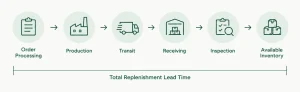
Focus on total replenishment lead time, not only the supplier’s quoted production time. Recalculate the reorder point whenever actual lead-time variability changes materially.
Supplier Collaboration as an Inventory Planning Tool
Supplier collaboration is the structured exchange of demand, order, specification, compliance, and lead-time information between a distributor and manufacturer to reduce supply and inventory risk.
Useful practices include sharing rolling forecasts, establishing scheduled replenishment programs, agreeing on standard specifications and tolerances, receiving advance notice of material changes, maintaining complete food-contact documentation, tracking actual rather than quoted lead times, and exploring supplier-held inventory for predictable long-lead programs.
Clear commercial agreements on stock ownership, call-off quantities, and replenishment responsibilities are essential. Documentation completeness and lead-time consistency should be part of supplier qualification alongside price and product range.
For example, Singreen supplies food packaging through wholesale and OEM/ODM programs and can support distributors seeking clearer specifications, compliance documentation, and more predictable repeat-order supply—factors that directly influence how much safety stock a distributor must carry. See also the company’s food packaging manufacturing capabilities.
Food-Contact Compliance and Sustainable Packaging Range Gates
A compliance gate is a documented verification step used to confirm that a packaging product and its relevant components are suitable for the intended food-contact application before the SKU is actively stocked or promoted.
For U.S. distribution, evaluate the regulatory status of the individual components under the applicable pathways (21 CFR, GRAS, prior sanctions, Threshold of Regulation, or Food Contact Substance Notifications). [1][2] Avoid treating “FDA compliant” as a generic product-level approval. Documentation should correspond to the actual material, intended food type, and conditions of use. [4]
Sustainable packaging requires the same discipline. When evaluating plant-based options, distributors should review available plant-based packaging materials against documentation, supply consistency, and end-of-life claims. Before promoting an item as a core SKU, confirm material composition, support for recycled-content or compostability claims, clarity of the intended end-of-life route, consistency of supply, and commercial viability of quantities and lead times. This separates documented attributes from unsupported sustainability language.
Quarterly Product Range and Inventory Review
A quarterly review is a structured assessment of SKU performance, demand changes, inventory exposure, supplier performance, and compliance status.
| Review Question | Metric or Evidence | Possible Action |
| Has customer demand changed? | ABC/XYZ migration | Reclassify SKU and adjust stock policy |
| Are core SKUs sufficiently available? | Stockouts, fill rate, days on hand | Adjust safety stock or replenishment |
| Are custom SKUs creating obsolete inventory? | Open orders, forecast coverage, specification changes | Move to program-based planning |
| Is replenishment aligned with actual lead time? | Average and standard deviation of lead time | Recalculate reorder point |
| Are compliance documents current? | Regulatory documentation and specification records | Pause or review the SKU if documentation is incomplete |
| Are slow movers still commercially justified? | Sales contribution, margin, customer dependency | Rationalize, special-order, or discontinue |
Review high-volume core SKUs more frequently, custom programs on a program basis, and the full portfolio at least quarterly. Adjust frequency when demand volatility or supplier performance changes.
FAQ
Q1: What is the difference between product range planning and SKU rationalization?
Product range planning decides what a distributor should carry. SKU rationalization decides which existing SKUs should remain, be consolidated, or be removed. Review existing performance before continuously expanding the range.
Q2: How should distributors decide between standard and custom food packaging?
Standard packaging suits aggregated demand and replenishment stock. Custom packaging is better managed against confirmed customer programs. Avoid speculative inventory for customer-specific printing, dimensions, or materials.
Q3: How should safety stock be calculated for imported food packaging?
Account for both demand variability and actual replenishment lead-time variability. Fixed weeks-of-supply rules often hide the real source of risk. Collect real lead-time data and include meaningful variation in the planning model. [3]
Q4: What documentation should distributors request for food-contact packaging?
Documentation should support the intended food-contact use under the applicable regulatory pathway. For U.S. applications, evaluate the relevant 21 CFR provisions, Food Contact Substance Notifications, GRAS status, or other pathways, matched to the actual material, food type, and conditions of use. [1][2][4]
Q5: How often should food packaging inventory be reviewed?
Match frequency to demand velocity, variability, lead time, and business importance. High-volume core SKUs may need weekly or biweekly review; custom programs follow program schedules; the broader portfolio can be reviewed quarterly. Adjust when supplier lead-time variability changes.
Q6: How can distributors reduce inventory risk when importing packaging?
Improve demand visibility, separate standard and custom policies, monitor actual lead-time variability, avoid speculative custom stock, establish scheduled replenishment, consider supplier-held inventory for predictable long-lead items, and keep compliance and specification documents current.
Conclusion
Effective food packaging range and inventory planning aligns product selection, inventory depth, replenishment timing, compliance requirements, and supplier capability with actual B2B demand.
The practical model is to:
- Build the range around customer demand and application requirements.
- Keep high-volume standard SKUs reliably available.
- Manage custom SKUs around confirmed or repeatable programs.
- Differentiate inventory policies with ABC/XYZ analysis.
- Calculate safety stock from actual demand and lead-time variability.
- Set replenishment cycles according to SKU characteristics.
- Use supplier collaboration to improve supply predictability.
- Apply compliance and sustainability documentation gates before expanding the active range.
- Review the portfolio regularly and remove inventory that no longer creates sufficient commercial value.
A larger catalogue does not automatically create a stronger business. A well-structured portfolio with reliable availability, controlled inventory exposure, and qualified suppliers provides a more sustainable foundation for B2B growth.
References
[1] U.S. Food and Drug Administration — Understanding How the FDA Regulates Substances that Come into Contact with Food
https://www.fda.gov/food/food-packaging-other-substances-come-contact-food-information-consumers/understanding-how-fda-regulates-substances-come-contact-food
[2] U.S. Food and Drug Administration — Determining the Regulatory Status of Components of a Food Contact Material
https://www.fda.gov/food/packaging-food-contact-substances-fcs/determining-regulatory-status-components-food-contact-material
[3] ASCM — Safety Stock and Demand Variability
https://www.ascm.org/ascm-insights/safety-stock-a-contingency-plan-to-keep-supply-chains-flying-high/
[4] U.S. Food and Drug Administration — Food Types & Conditions of Use for Food Contact Substances
https://www.fda.gov/food/packaging-food-contact-substances-fcs/food-types-and-conditions-use-food-contact-substances
[5] Precedence Research — Food Packaging Market Size (2025–2026 data)
https://www.precedenceresearch.com/food-packaging-market